
The Gilded Cage
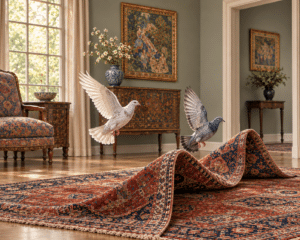
From that royal palace
which once rose to the sky,
Monarchs in splendor faced the world.
But on its turrets I have seen a ring-dove seated,
Cooing, cooing over and over: where, where?
— Omar Khayyam
Translated by Michael Hillmann
The bird motif in Oriental rugs is perhaps the most prevalent and recognizable of all motifs. One of the earliest examples can be found in the Pazyryk carpet, discovered in the Siberian Altai Mountains by Soviet archaeologist Sergei Rudenko in 1949. Within the inner and outer guard borders of the carpet are alternating rows of griffins, mythological creatures with the bodies of lions and the heads, beaks, and wings of eagles.
In other rugs and carpets dating from the 16th to the 19th centuries, one finds realistically depicted birds reflecting Persian mythology. Ferdowsi’s Shahnameh, Book of Kings, and Attar’s Conference of the Birds, featuring the mythical Simurgh, immediately come to mind. Birds also served as poetic metaphors for the human soul, transcending earthly existence and ascending toward spiritual enlightenment.
These themes have been depicted, in one form or another, in Persian rugs since at least the 16th century.
I have prefaced my remarks with this brief historical background so that I can return to the story of a rather unusual find I made back in 1989.
My brother Sam and I had opened our first rug shop in southwest Minneapolis. We were novices, with little prior experience in the rug business. A combination of kismet and hard work, along with a little borrowed money, helped us get off the ground and establish a platform for a new life.
When we first opened our store, we decided to operate primarily as a service company. We called it Oriental Rug Services, a name we thought would explain and summarize our activities: cleaning and repairing handmade rugs. I had learned a few things about repair from an old-timer in the business, while my brother decided to learn about cleaning. He started by experimenting with various vacuum cleaners and shampoos.
Since we had no capital to purchase inventory, we decided instead to use what little money we had to buy old rugs and resell them to dealers in New York. At the time, there was a fairly active market for old and antique rugs, particularly in Europe.
Bird Lady
So, one afternoon, when the bird lady walked into our store, we were busy cleaning and repairing rugs.
She was a quiet woman, perhaps in her early forties, accompanied by another woman who appeared somewhat older. She didn’t say much, and most of the conversation was handled by her companion.
“My friend here has some rugs,” the older woman said.
I asked whether they were handmade. She replied that they were, and that they were old.
“She doesn’t live too far away, just around the corner by the creek,” she added. The younger woman, whom I presumed was the owner of the house, remained quiet, carefully watching me and following our brief conversation.
That same afternoon, I walked the short distance to her house. It was a 1920s bungalow that looked quite ordinary from the outside. The door was open, so I knocked and walked in. Within moments, I noticed an extremely strong stench that seemed to have permeated the entire house, something akin to the smell of a leaking gas pipe mixed with animal manure.
Naturally, my eyes went straight to the floors. The living room was covered with an antique Heriz, a massive Persian rug from the early 1900s. In the dining room was an antique Peking, a Chinese rug from roughly the same period. Under my feet lay a Kurdish foyer rug, also from that era. All three were covered in bird droppings, to the point that their patterns were barely recognizable.
The older woman, whom by now I had begun to regard as some sort of legal decision-maker or guardian, was still there, along with the younger woman. Both greeted me with utmost ordinariness, showing no reaction whatsoever to the condition of the house or its all-encompassing stench.
“Here they are, all the rugs,” the older woman said, while the younger one looked on.
“I see,” I replied, politely and discreetly covering my mouth and nose. By now, breathing had become difficult. With my asthma kicking in, I could hardly say much.
“So, are you interested?” the older woman asked.
I walked away and began examining each rug closely, trying to figure out what I was looking at. Deciphering their patterns and assessing their condition under the circumstances was extremely difficult. At that point, all I really wanted was to get out of the house. Something, however, compelled me to stay. For one thing, I was curious about the rugs and, deep down, felt they were worthy pieces. At the same time, I had no idea whether they would disintegrate during cleaning or even survive the process. Was there anything there worth saving? I kept asking myself.
I also didn’t want to be impolite. I thought that if they were pretending everything was normal, I should follow their lead and pretend the same.
“Yes, I am interested,” I said. “But I have to find someone who can get them out of here.”
The older woman once again took the lead.
“How much will you give us for them?” I explained that I couldn’t really make a decision on the spot, given how difficult it was to assess the rugs. Nevertheless, I offered her a respectable price, considering that I had no way of knowing what I was getting myself into.
The scene conjured up all sorts of memories and, inevitably, some humorous associations. I couldn’t help thinking of Alfred Hitchcock’s The Birds, or, for that matter, Mel Brooks’s High Anxiety, his affectionate send-up of Hitchcock’s films.
I returned to the shop bewildered by the whole experience. Rugs made close to a century earlier by Iranian weavers had somehow found their way to Minneapolis, into a house most likely owned by people of means, only to be abandoned to the birds. The tragic state of the house was matched only by the tragic expressions on the faces of the two women I had encountered.
Was this a surreal dream, or simply part of the life I had chosen for myself here in the U.S., only six or seven years after my arrival?
I told one of our employees—the only one besides my brother and me—that I would offer him a good tip if he was willing to go to the house and pick up the rugs for us.
Revealing a Woven Sunrise
It took us days to clean the rugs. Layer by layer, we managed to remove the bird droppings. At each stage, more color and pattern began to emerge, gradually restoring the magic and luster that had once been there.
By the time we had completed the cleaning and repair, we knew we were in possession of some very fine rugs. Certainly not museum-quality pieces, but old rugs of classic design, representing the finest traditions of Oriental rug weaving.
The mystery of the two women and my brief encounter with them cannot be fully explored so many years after the fact. What motivated the people who owned the house to keep pigeons indoors and live amid such unsanitary conditions? Was the woman who lived there simply abandoned to her own mental condition, without help or supervision?
One cannot entirely dismiss a surrealist reading of the whole experience. It is as though Salvador Dalí, René Magritte, and André Breton had collaborated to create an interpretation of a 16th-century Persian miniature painting. The birds had flown out of the rugs and taken their revenge on those who had abandoned them.
Weeks later, a few New York dealers came to visit us and purchased two of the rugs. The third, commonly known as a Chinese Peking, had suffered the least damage. It was purchased by a rug repairman from the ancient city of Ardebil in Iran, who happened to live and work in Minneapolis. He said he could repair it if we offered it at a good price, and we did.
I still walk by the house near Minnehaha Creek and wonder about the bird lady and her rugs. Who knows what possessions might be in that house now? But I have never seen pigeons flying out of it.